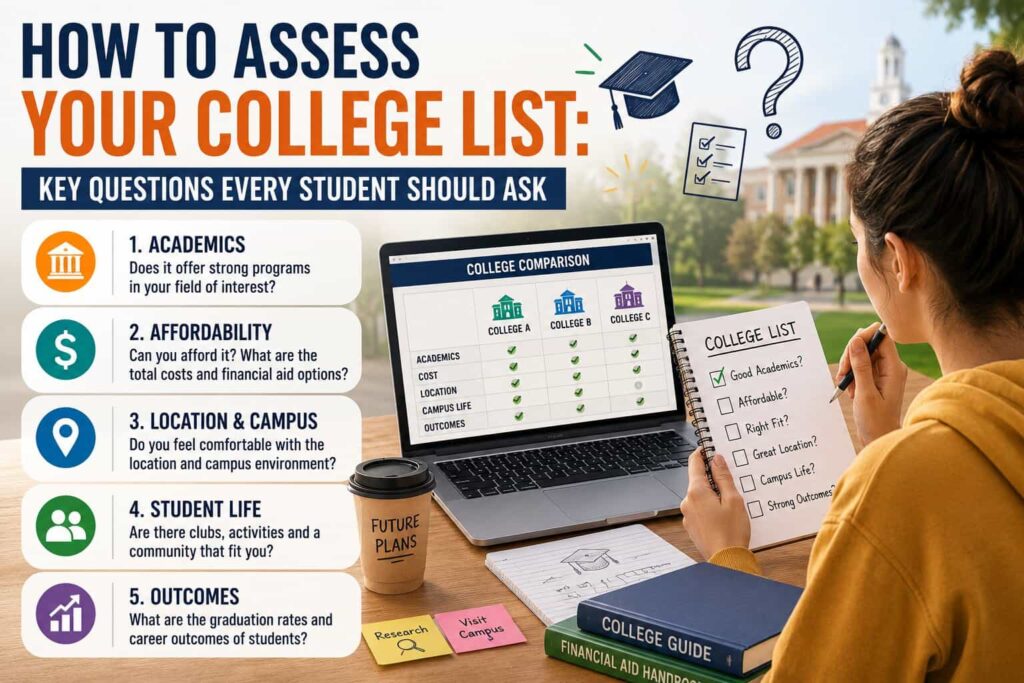

Assembling a lineup of colleges is an exciting step, but it can fast turn into overwhelming.
You don't just wish schools that sound solid—you require ones that are the right suitable academically, financially, and socially.
Published on July 1, 2026, this College Board manual recommends answering targeted questions about each institution on your set.
This article walks you through those questions, outlines why they matter, and how to discover the answers.
By evaluating aspects like location, scale, selectivity, cost, financial aid, and graduation rates, you can contrast schools objectively.
You'll also grasp how to use resources like the U.S.
Department of Education's College Scorecard to verify claims.
Start your search with a sturdy framework and steer clear of typical pitfalls.
Quick takeaways
- Location matters for charge of living, travel, and personal comfort—every time find the college on a map.
- Verify the college's selectivity ratio (admit rate) to gauge your chances of admission.
- Consistently verify overall sum annual expense and what financial aid packages are open before registering.
- Glance beyond sticker price: four-year graduation rates, retention rates, and on-campus housing guarantees reveal genuine merit.
- Accreditation and certification exam pass rates are critical for career-focused programs.
- Apply the College Scorecard to get formal figures on outcomes, debt, and earnings.
As you create a lineup of colleges that interest you, be sure you can answer these questions about them. — College Board, July 1, 2026
Why Location and Size Matter More Than You Think
Where a college is located affects your everyday life, travel expenses, and even internship chances.
Can you locate the school on a map?
Consider climate, proximity to home, and whether you prefer an urban, suburban, or rural setting.
Scale also plays a major role.
Understand the full undergraduate enrollment—small schools regularly give more personalized attention, while big universities provide more resources and mix.
Inquire yourself whether you thrive in smaller classes or larger lecture halls.
Academic Fit: Majors, Course Requirements, and Program Strength
Before putting in, verify that the college presents majors that genuinely interest you.
Don't halt at the catalog—inspect if courses you want are on offer each semester and at convenient times.
Graduation needs can vary broadly.
Some schools call for a core curriculum; others are more adaptable.
Also investigate distinct programs such as study abroad, internships, and research opportunities.
Request existing students, faculty, or alumni about the strongest academic departments.
- Have you completed the high school coursework the college calls for for admission?
- What courses must graduate in your intended primary?
- Are needed and elective classes offered consistently, without extended waitlists?
- Does the college give internship, study abroad, or cooperative education programs in your field?
Selectivity, GPA Ranges, and Your Admission Chances
A college's selectivity ratio—the percentage of applicants admitted last year—gives you a fast meaning of how competitive admission is.
More selective schools normally admit fewer than 30% of candidates; less selective ones may admit over 70%.
Weigh your high school GPA with the variety of GPAs of freshmen enrolled last year.
If your GPA falls within or above that span, you’re a more competitive candidate.
Be realistic: even with excellent stats, extremely selective schools can be a reach.
- What was the college's admit rate last year?
- What were the middle 50% GPAs of admitted freshmen?
- Beyond GPA, do your test scores (if called for) and extracurriculars align with the ordinary admitted student profile?
Cost, Financial Aid, and Affordability
College charges involve tuition, fees, room, board, books, and personal expenses—the overall sum per year can exceed the sticker price.
Every time inquire for the complete price of attendance, not just tuition.
Alike important is the sort and sum of financial aid available.
Research scholarships, grants, work-study, and loans.
Review the financial aid deadlines—they may differ from admission deadlines—and the needed forms (FAFSA, CSS Profile, etc.).
- What is the full estimated charge per year?
- What percentage of students obtain need-based or merit-based aid?
- What financial aid forms are required and when are they due?
- Does the school encounter packed demonstrated demand for all admitted students?
Retention, Graduation Rates, and Housing
Two pivotal metrics reveal student satisfaction and institutional effectiveness: first-year retention rate (how many freshmen return for sophomore year) and graduation rates (percentage earning a degree in four, five, or six years).
High retention and on-time graduation suggest sturdy assist and apt.
Also request whether freshmen are guaranteed on-campus housing.
If not, learn about off-campus choices and prices.
Living arrangements straight bearing your first-year expertise and budget.
- What percentage of first-year students give back for their sophomore year?
- What are the four-year, five-year, and six-year graduation rates?
- Is on-campus housing guaranteed for freshmen? If not, where do most students reside?
- How many students dwell off campus overall?
Social Life, Extracurriculars, and Campus Culture
Your college know-how extends far beyond the classroom.
Explore extracurricular activities that interest you—clubs, sports, student public sector, arts, and volunteer prospects.
Check if the college is coed or lone sex, and what the social scene is like.
Call on the college if doable.
During a campus tour, pay attention to the environment: do the pictures and language on the website match reality?
Speak to present students about their general impression of the school.
Your comfort on campus is a robust indicator of fit.
- Are there student bodies, sports, or cultural groups that match your interests?
- What is the social atmosphere? Is it competitive, collaborative, party-oriented, or hushed?
- Does the college present assets for mental health, profession offerings, and academic aid?
Accreditation, Certification Pass Rates, and the College Scorecard
Accreditation guarantees the college meets standard standards.
Regional accreditation is the most recognized.
If you plan to enter a licensed profession (nursing, teaching, engineering), check how many students pass the called for certification exam.
The U.S.
Department of Education's College Scorecard is an authorized, complimentary utility that provides records on graduation rates, average annual expense, median earnings after graduation, and student loan debt.
Employ it to verify and compare claims made by colleges.
- Is the college regionally accredited?
- For your intended major, what is the pass rate on the skilled certification exam?
- What does the College Scorecard reveal about graduation rates, average debt, and post-graduation earnings?
The Admission Process: Deadlines, Essays, and Interviews
Each college has its own submission timeline.
Remark application deadlines (early decision, routine decision, rolling) and check what the application needs—essays, letters of recommendation, test scores, and portfolios.
Some colleges recommend or need an meeting.
Find out whether meetings are conducted by admissions workforce or alumni, and whether you can schedule one during a campus stop by.
Also inquire about campus call on policies and stop by day alternatives.
- When are submissions due?
- What components must the submission cover (essays, recommendations, etc.)?
- Is an meeting suggested or needed? Is it open on campus or with alumni?
- What are the financial aid deadlines and called for forms?
Final Self-Reflection: Honest Answers About Your Candidacy
After gathering all this details, request yourself three last questions.
First, am I a powerful applicant for admission here?
Contrast your academic profile with the college's admitted student data.
Second, if I'm not a sturdy applicant, what are my realistic chances?
Evaluate reaches, matches, and safeties.
Third, do I desire to call on this college?
A stop by can confirm or change your impression.
Finally, what additional info do I still require?
Whether it's talking to a current student or checking exam pass rates, load in any gaps before registering.
Quick Reference: Key Questions for Every College on Your List
| Category | Question to Answer |
|---|---|
| Location | Where is the college and can you find it on a map? |
| Size | How many undergraduates are enrolled? |
| Selectivity | What percentage of applicants were admitted last year? |
| Academics | Does the college offer majors and courses you need? |
| Cost | What is the total cost per year and what financial aid is available? |
| Retention | What percentage of freshmen return for sophomore year? |
| Graduation | What are the 4-, 5-, and 6-year graduation rates? |
| Housing | Are freshmen guaranteed on-campus housing? |
| Extracurriculars | Are there clubs, sports, or activities that interest you? |
| Accreditation | Is the school accredited and what are certification pass rates? |
| Admission | When are applications due and what is required? |
| Financial Aid | What are the financial aid deadlines and forms? |
Frequently Asked Questions
How do I discover a college's selectivity ratio and GPA ranges?
Most colleges publish their Widespread Information Place, which includes admitted student statistics.
You can also check the College Board's BigFuture or the College Scorecard for admit rates and GPA ranges.
If the data isn’t online, contact the admissions office straight.
What if a college doesn't need test scores—should I still report them?
Many colleges are test-optional, significance you can settle on whether to hand in SAT/ACT scores.
If your scores are above the school's middle 50% span, reporting them can strengthen your submission.
If they’re below, evaluate omitting them.
Inspect each college's specific policy.
How can I weigh financial aid gives from varied colleges?
Appearance at the net cost—the total price minus grants and scholarships.
Use each college's net rate calculator to estimate your actual charge.
Also weigh loan amounts: lower loan debt is better.
The College Scorecard demonstrates average debt and earnings for graduates.
What does 'first-year retention rate' inform me about a college?
A high retention rate (above 90% is excellent) indicates that most freshmen are satisfied enough to go back.
It advises reliable academic support, solid campus life, and a strong suitable.
Modest retention may signal issues with academics, social environment, or affordability.
Should I call on every college on my lineup before putting in?
Visiting is ideal but not every time doable.
If you can’t call on campus, grab a virtual tour, attend an online info session, and speak to existing students or alumni.
At minimum, research thoroughly before applying, and strategy to stop by after acceptance if you’re deciding between multiple gives.
How key is the College Scorecard when evaluating a school?
The College Scorecard is a reliable, unbiased source of official information on graduation rates, average annual cost, median earnings after graduation, and student loan repayment rates.
It aids you verify claims and contrast schools on objective outcomes.
Use it alongside campus visits and guidebooks.
Final Thoughts
Evaluating your college list isn’t a one-time duty—it’s an ongoing procedure of research and reflection.
By systematically answering these questions for each school, you’ll develop a balanced set of reaches, matches, and safeties that align with your academic goals, financial situation, and personal preferences.
Don't rush: use references like the College Scorecard, BigFuture, and college websites to assemble exact data.
Once you’ve evident answers, you can confidently settle on where to put in and, eventually, which provide to accept.
Kick off today by pulling up your list and running through each question.
Your future self will thank you for the attentive work.